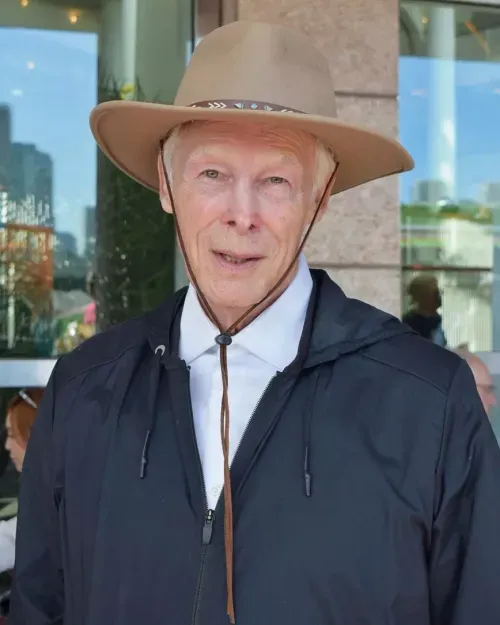
The Magic and Many Lives of the Greatest LSD Producer in History
Leonard W. Pickard (1945, Atlanta) is an emblematic and visionary figure in the history of psychedelics. The greatest LSD producer in history, according to the DEA, he showed an exceptional talent for science from a young age. The attraction to the counterculture of the 1960s led him to leave Princeton University and move to San Francisco, where he became friends with Tim Scully and Nick Sand, pioneers in large-scale LSD distribution.
After years in hiding, multiple arrests, and convictions, he enrolled in Harvard’s Kennedy School, where he predicted the fentanyl crisis in his 1996 doctoral thesis—long before it became an epidemic. Arrested in 2000 and sentenced to double life imprisonment in a maximum-security prison, he managed to handwrite The Rose of Paracelsus, an autobiographical novel that explores the lives and ideals of a group of clandestine LSD chemists.
Miraculously, he was granted parole in 2020, and at 82 years old, he feels that life has given him a second chance. Facing the serene, calm, and reflective man he is today, it's hard to imagine the avid spiritual explorer and clandestine chemist he once was. In this interview, this hero of the psychedelic counterculture reflects on his many lives.
Tell us about your origins.
I was born in 1945, right at the end of World War II, in Atlanta, Georgia. Rural Georgia is full of descendants of Scots and Irish, many of whom joined the army. So, we saw many return from the European drama, and many who didn’t. I remember that in my church, when I was a child, there were many fatherless children. It was touching, although I didn’t realize the gravity of it until later in life. Despite everything, I grew up relatively happy as a Southern boy: pine forests, many walks, a Southern lifestyle.
My family was mostly academic. My father was a lawyer, and my mother worked as a mycologist at the Centers for Disease Control and Prevention in Atlanta. So, our house was often full of visiting scientists from all over the world—from Spain, South America, China... In high school, I was somewhat of a local magician. I participated in many science competitions, and in fact, I won the nationals.
How did your interest in psychedelics begin?
I went to study at Princeton and almost immediately dropped out for the pleasures of the 60s. One way or another, we all ended up in San Francisco when we were very young. Those were the early days of large-scale LSD distribution, and the people responsible for that were Tim Scully and Nick Sand, the main chemists of the Brotherhood of Eternal Love. Well, Owsley preceded them with a production of five million doses, and Tim and Nikki later surpassed him with a production of 20 to 30 million doses. Nikki, after being arrested by the DEA and convicted, was released on bail and fled. During the 20 years he was a fugitive, he produced an additional 13.5 kilograms of LSD, which easily amounts to 260 million doses.
Nikki was finally arrested in Canada in 1996 and brought to the U.S. to face the earlier charge he received in the early 70s, when he was sentenced to only 15 years. Back then, they usually served a third of their sentence, so he returned to the U.S. where he served six years and then spent the rest of his life with Usha, his lovely new wife. Nikki passed away in 2017 during the MAPS conference in Oakland. One day, he participated in the conference, receiving great recognition and hugs from the audience, and the next day, he had a heart attack. Moving tributes were held for him in San Francisco. Even from prison, I managed to send a fragment of a poem to be read in his honor. I held a special regard for Nicky; in my youth, he was something of a hero to me.
I remember attending Tim and Nikki’s trial after the Brotherhood in 1976, at the Federal Building in San Francisco. At that time, I had an Afro-style curly hair and showed up in a blue velvet jacket, a necklace of moons and stars, and that kind of thing. The federal agents didn’t know who I was, attending the trial like that, nor what to do with me. I handed out roses to the defense members, and Judy, Nikki’s wife at the time, distributed buttons that said, “We’re all in this together.” Today, those would be real collector’s items.
The prediction of the fentanyl crisis
After several years as a clandestine chemist and some arrests, you joined the Kennedy School of Government under the mentorship of Mark Kleiman, where you predicted the future fentanyl crisis. Tell us about this story.
Mark Kleiman was the main drug policy expert in the U.S. He was a former policy chief of the Department of Justice. When I met him, he was an associate professor of Criminal Justice at Harvard’s Kennedy School of Government. We met at a MAPS conference, and I told him I would love to go to the Kennedy School, although I was aware that due to my past, it would be unlikely. However, he encouraged me to apply, and so I did. Miraculously, I was admitted.
Mark was looking for someone who could articulate life in the underground world and the nature of drugs, and specifically, someone who could provide information on the future situation: What drugs would be on the streets in the coming years? What would be the next drug of abuse? At that time, in ’92-’93, we only had the legacy substances: cocaine, heroin, methamphetamine, and cannabis, with no analogs. We felt it would be some analog that no one had heard of because there were significant advances in Pharmacology and Medicinal Chemistry, and the pharmaceutical industry was constantly developing new compounds.
We sensed that extraordinary things would happen, although some would be very harmful. There would be drugs that would spread rapidly worldwide and cause major problems. But what would this drug be? Could we foresee what was coming? That’s what my thesis was supposed to address.